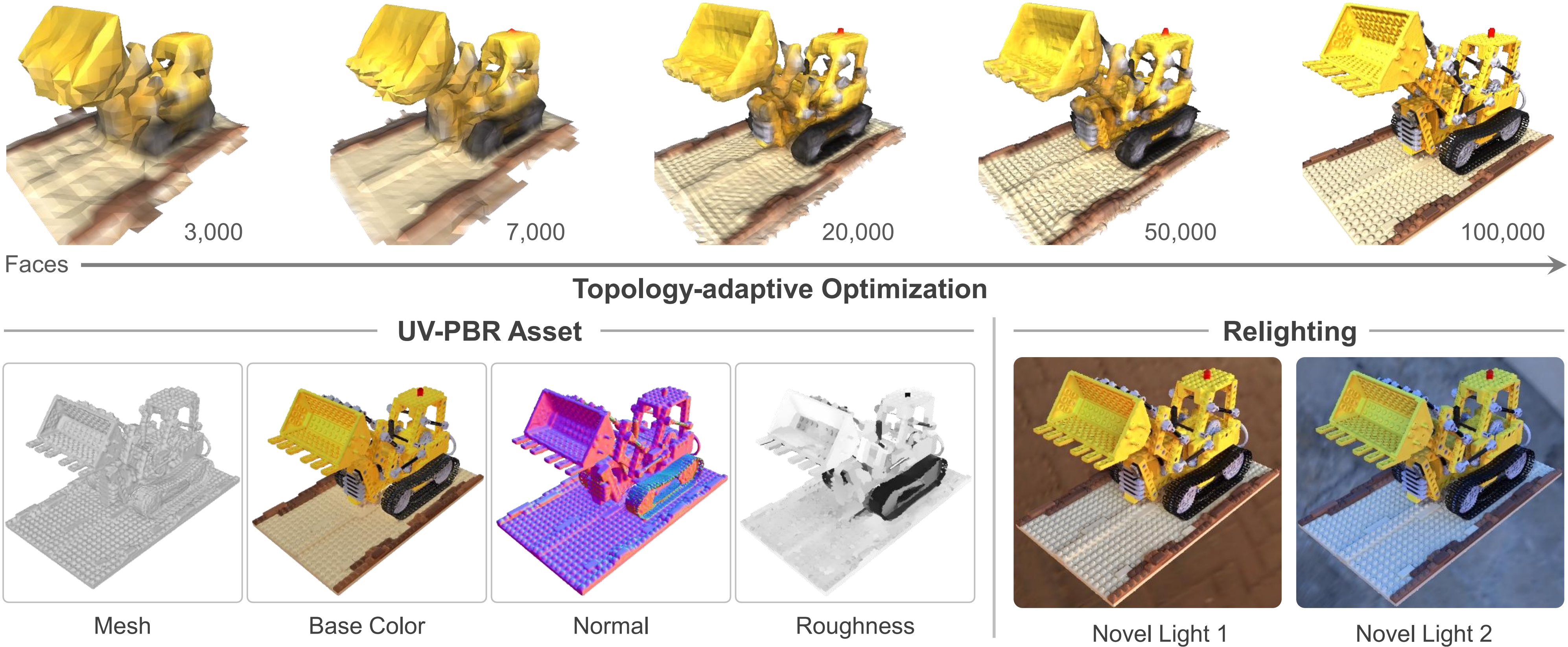
Topology-adaptive UV mesh reconstruction
Vertex splitting and merging refine explicit geometry and connectivity while local updates keep the UV parameterization valid.
University of Science and Technology of China · Alibaba Group, Amap
01 · Overview
Mesh geometry and topology are directly optimized through vertex splitting and merging, with consistent UV updates during topology changes.
The reconstructed mesh and UV coordinates are frozen before optimizing explicit PBR maps and environment lighting, reducing compensation among geometry, materials, and illumination.
One-bounce diffuse indirect lighting traces secondary rays and queries the same UV-PBR maps, without introducing a learned residual appearance field.
The resulting compact mesh and material maps can be directly relit and edited in standard graphics tools.
ExMesh++ extends our previous ExMesh framework from explicit mesh reconstruction to complete relightable asset reconstruction. Visit the ExMesh project page
02 · Video
03 · Interactive Results
Explore the exported UV-PBR assets in real time while geometry and materials remain fixed and only the environment illumination changes. This browser preview uses direct environment lighting only and does not include the one-bounce indirect illumination used by our offline renderer.
Preparing the interactive viewer…
The interactive viewer could not be loaded.
Drag to rotate · Scroll or pinch to zoom
04 · Method
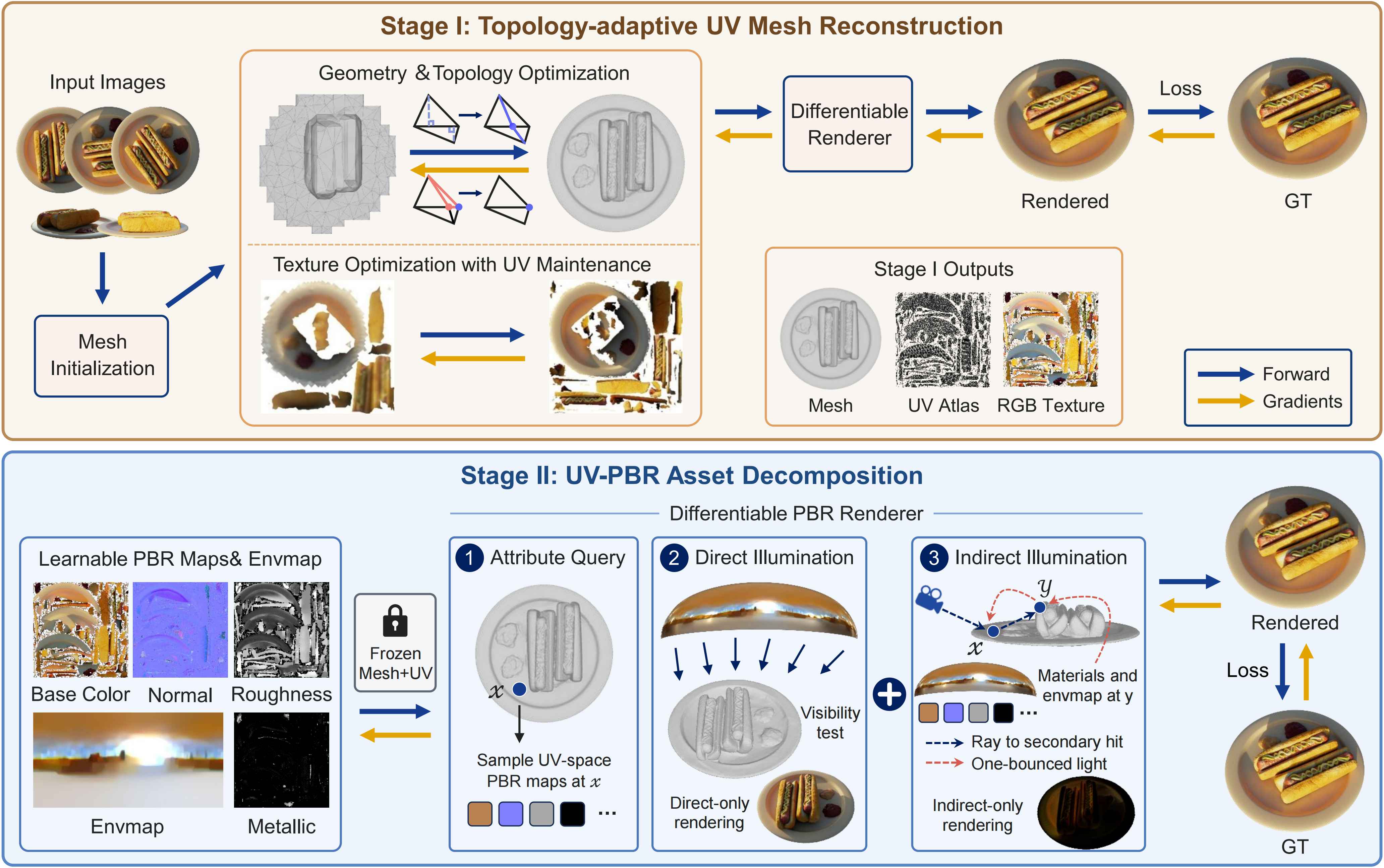
Vertex splitting and merging refine explicit geometry and connectivity while local updates keep the UV parameterization valid.
The mesh-UV carrier is frozen while shared material maps and environment lighting are optimized for direct and one-bounce illumination.
05 · Results
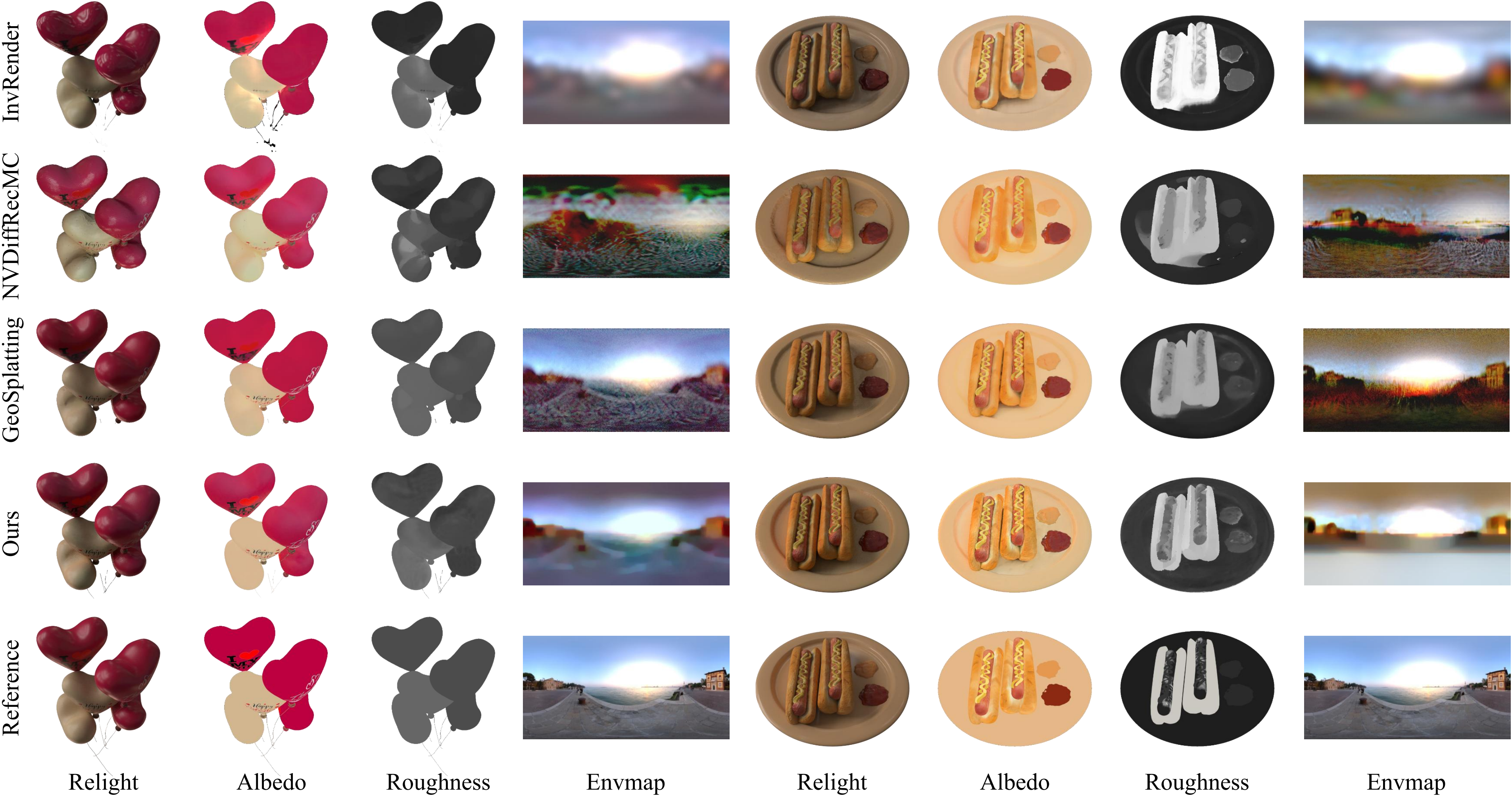
On Synthetic4Relight, ExMesh++ recovers cleaner albedo, roughness, and environment lighting while preserving convincing appearance under novel illumination.
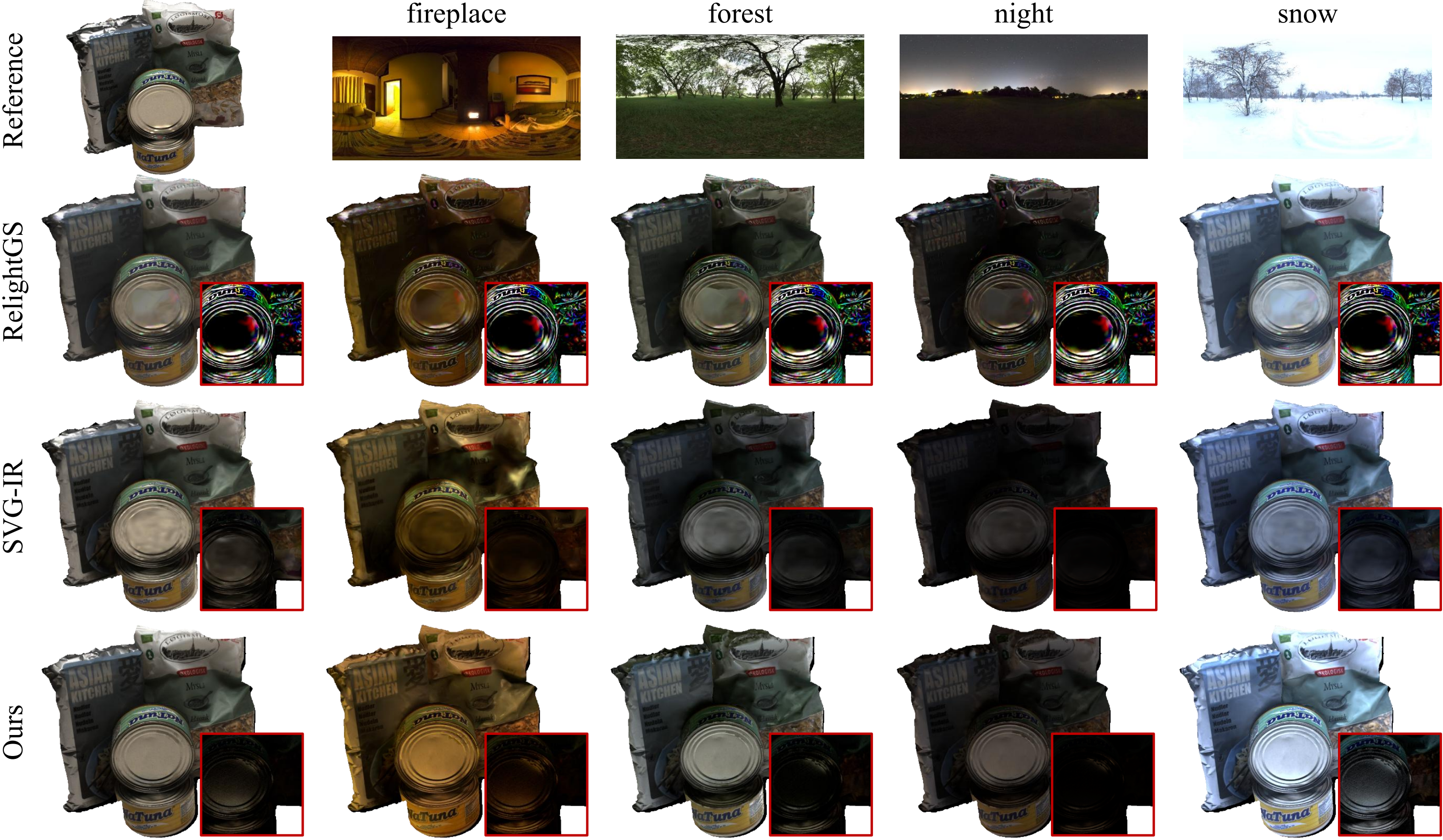
Secondary-ray tracing queries the same shared UV-PBR materials, producing smoother, illumination-dependent indirect components around occlusions and nearby surfaces.
06 · Citation
If you find this work useful, please cite our paper.
@article{fan2026exmeshpp,
  title   = {ExMesh++: From Multi-View Images to Relightable
             UV-PBR Mesh Assets via Topology-Adaptive
             Reconstruction and Decomposition},
  author  = {Fan, Chuanjin and Wu, Lifan and Chang, Wenjie and
             Chang, Hanzhi and Yang, Wenfei and Zhang, Tianzhu},
  journal = {arXiv preprint arXiv:2608.24109},
  year    = {2026}
}