Coarse-to-Fine Mesh Reconstruction
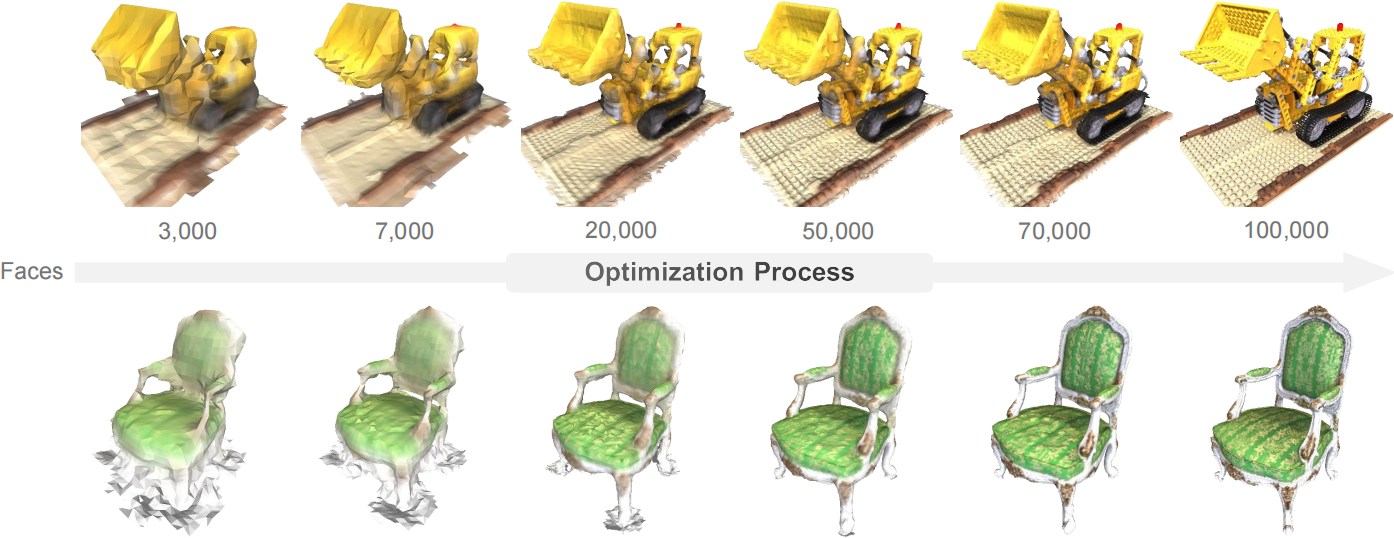
Explore how ExMesh progressively refines a compact coarse mesh into a detailed reconstruction.
Drag to rotate · Scroll or pinch to zoom · Use the slider to inspect each stage
Abstract
Reconstructing surface meshes from multi-view images has remained a core challenge in recent years. Most existing methods, whether implicit or explicit, depend on intermediate representations and post-processing steps like Marching Cubes or TSDF fusion, often resulting in artifacts and fragmented geometry. Directly optimizing explicit meshes is a promising approach. However, it presents two critical challenges: adaptively refining mesh topology to capture detail without introducing degenerate faces, and maintaining consistent UV coordinates for high-fidelity texturing as the mesh structure evolves.
To overcome these challenges, we propose ExMesh, a framework that directly optimizes explicit meshes by integrating differentiable optimization with discrete topology updates. We introduce adaptive vertex splitting and merging with real-time UV maintenance, enabling coarse-to-fine optimization while preserving geometric integrity. To our knowledge, ExMesh is the first framework that directly optimizes meshes with real-time adaptive topology refinement. Extensive experiments demonstrate a strong balance among accuracy, computational efficiency, and mesh conciseness.
Method Overview
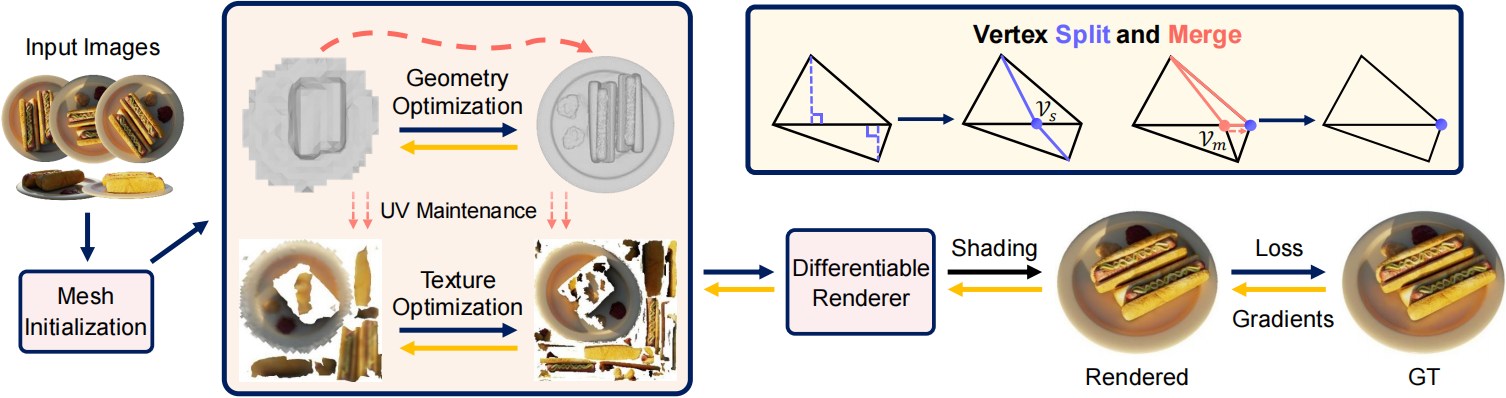
A differentiable renderer computes a photometric loss between the rendered and ground-truth images. Gradients drive two decoupled loops: geometry optimization for vertex positions and texture optimization for a separate UV map. Continuous optimization is interleaved with discrete vertex split and merge operations to adaptively refine topology.
Results
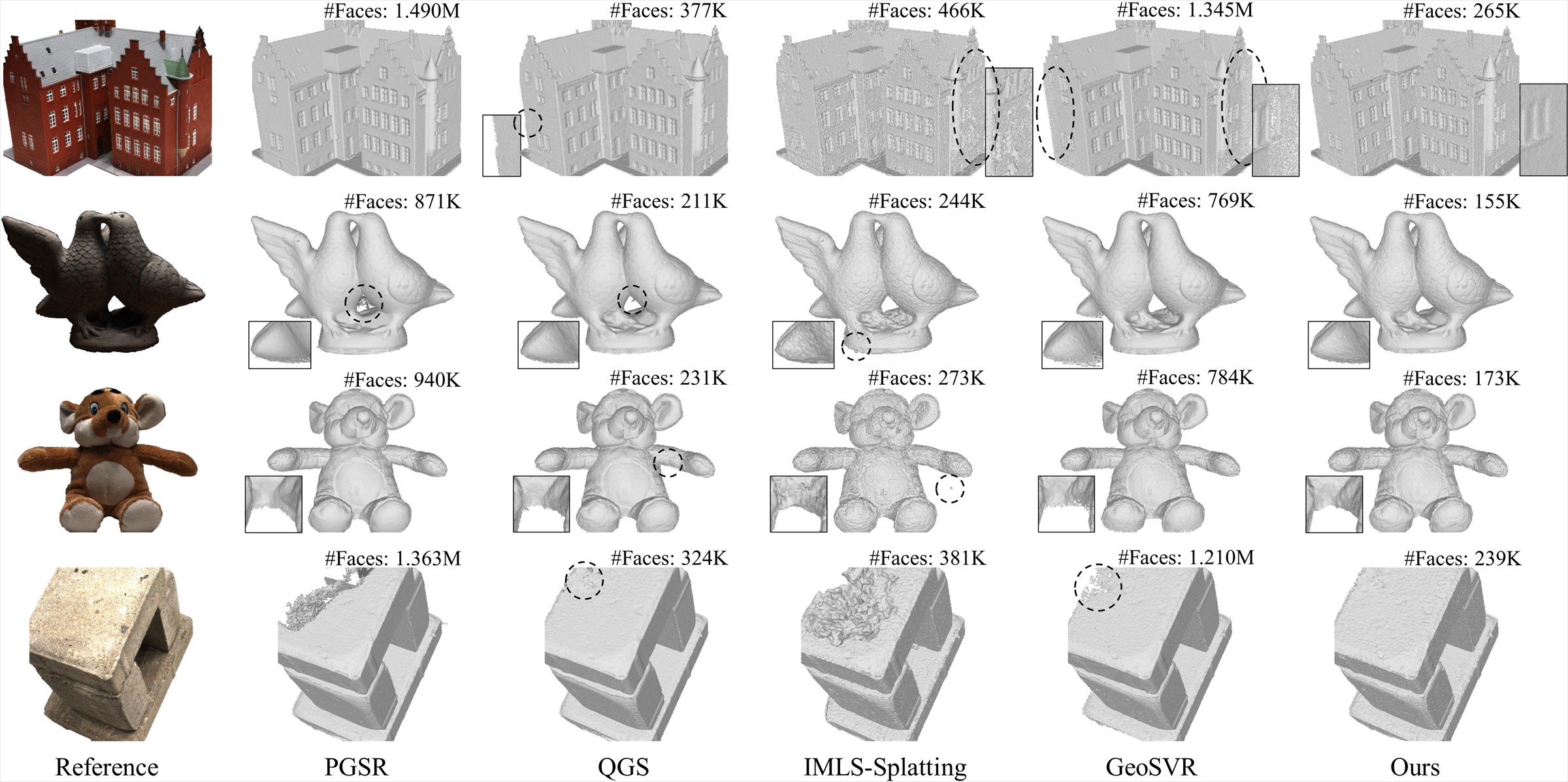
Qualitative comparisons on multi-view reconstruction benchmarks.
BibTeX
@inproceedings{Fan2026ExMesh,
  title     = {ExMesh: Explicit Mesh Reconstruction with Topology Adaptation},
  author    = {Chuanjin Fan and Lifan Wu and Wenjie Chang and Hanzhi Chang and Wenfei Yang and Tianzhu Zhang},
  booktitle = {Proceedings of the IEEE/CVF Conference on Computer Vision and Pattern Recognition (CVPR)},
  year      = {2026}
}