Stable warm-up
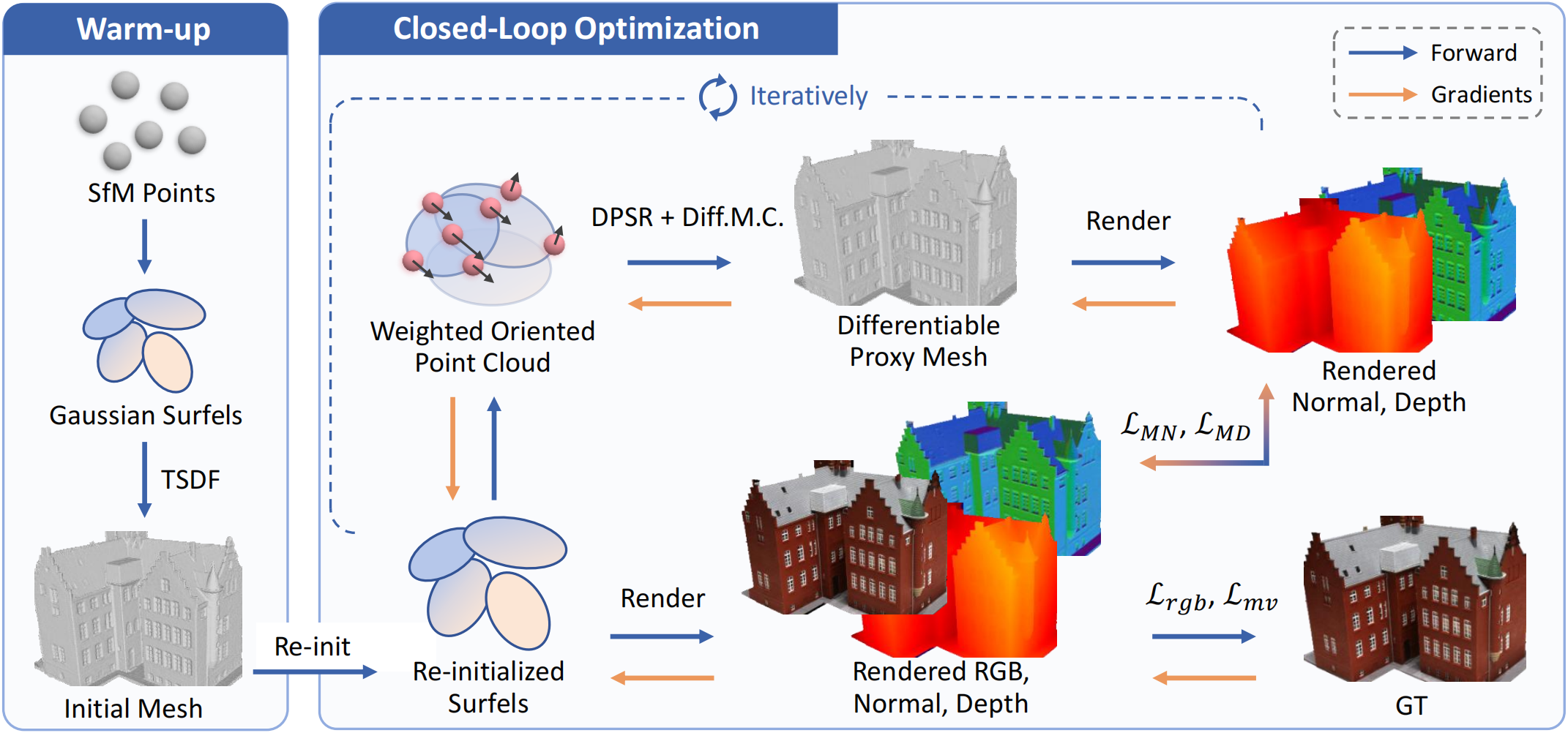
Initialize Gaussian surfels and an explicit surface prior from sparse multi-view observations.
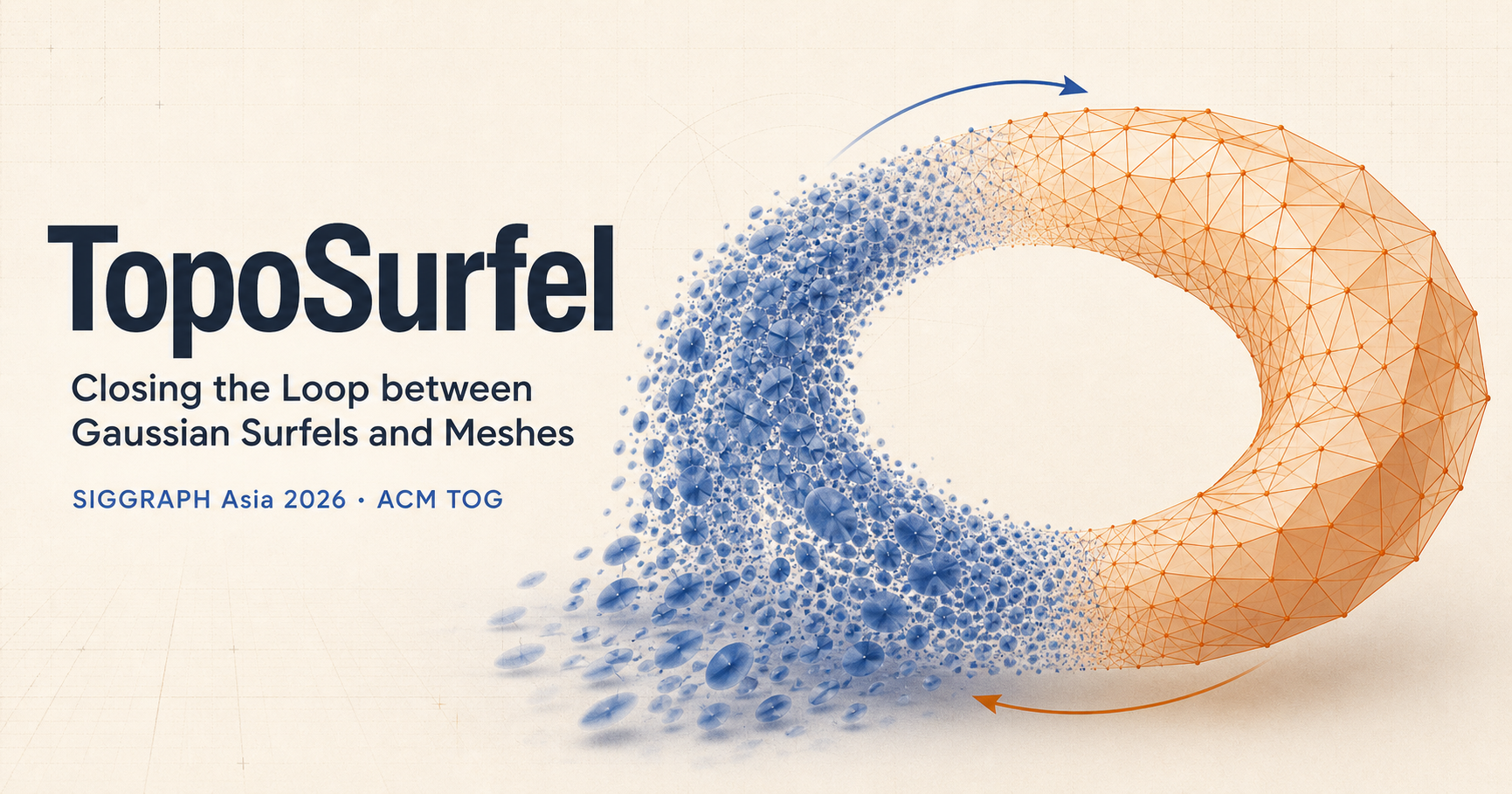
TopoSurfel is a lightweight surface reconstruction framework in which discrete Gaussian surfels and a continuous proxy mesh co-evolve, producing cleaner and more complete geometry without additional learnable parameters.
University of Science and Technology of China
Watch the full project video directly on this page.
Instead of extracting a mesh only after training, TopoSurfel continuously uses a differentiable proxy mesh as structured geometry guidance.
Initialize Gaussian surfels and an explicit surface prior from sparse multi-view observations.
Extract a continuous differentiable mesh directly from oriented surfels, without auxiliary networks.
Mesh-guided normals and density control suppress floaters, fill holes, and refine the next mesh.
Warm up once, then iteratively exchange geometry between the two representations.
Drag to rotate · Scroll to zoom · Double-click to reset
If you find this work useful, please use the following BibTeX entry.
@article{fan2026toposurfel,
  title   = {TopoSurfel: Closing the Loop between Gaussian
             Surfels and Meshes for Surface Reconstruction},
  author  = {Fan, Chuanjin and Chang, Wenjie and Liao, Bohao
             and Chen, Yujia and Yang, Wenfei and Zhang, Tianzhu},
  journal = {arXiv preprint arXiv:2608.20687},
  year    = {2026},
  url     = {https://arxiv.org/abs/2608.20687}
}